
What Are Biofloc and Land-Based Tanks—and How Do They Differ from Ponds and Cages?
Biofloc fish farming is a water-treatment approach used inside a land-based tank, where a microbial community is kept suspended and aerated. The tank is a container on land: a frame or wall, a flexible liner, an outlet, and a water supply the farm controls. Ponds rely on soil, sunlight and natural processes; cages sit in a lake, river or sea. A tank gives the farm control over volume, depth, drainage and aeration interfaces, and it puts the cost of pumping and treatment on the farm.
That difference matters. Pond construction costs and water control depend on the site. A cage borrows the water body and inherits its risks. Land-based tanks hold a defined volume that can be measured, drained and isolated between cycles, which supports separate management of production cycles. Biofloc fish farming adds one more requirement: the tank keeps the floc suspended and aerated while letting excess solids leave through a drain. The tank specification follows the system specification, never the other way round.
How Do Biofloc, RAS, and Flow-Through Systems Shape Tank Requirements?
The table maps three land-based approaches to their tank requirements.
| System | What the system needs | What it asks of the tank |
|---|---|---|
| Biofloc | A suspended microbial community, continuous mixing, aeration, and solids removal | A layout and outlet that move solids toward the drain, and room for diffusers |
| RAS | Mechanical filtration, a biofilter, aeration or oxygen, pumps and controls | A steady flow into the filter loop, a matching outlet and sump, and pipework space |
| Flow-through | A reliable clean water source and a lawful discharge route | An inlet and outlet sized to the flow, with temperature following the source |
In a biofloc tank, bottom aeration keeps particles suspended, and rounded layouts help avoid dead zones where sludge settles; the drain is purged periodically rather than run at a high continuous flow. In a RAS, mechanical filters and biofilters treat recirculated water; a circular tank can use rotational flow to move solids toward a central outlet. In flow-through, the risk is short-circuiting, where clean water exits out the drain, so overflow and outlet pipes must pass peak flow without backing up the water line.
The order matters: a tank bought before the system is designed fits aeration and solids removal into leftover space. A RAS that leaves the sump and return manifold until later loses floor space and hydraulic head it cannot recover. Flow-through is limited by its source, so tank size follows the available flow, not the other way round. Settle the system first, then write the tank specification against it.
FUUSHAN supplies the tank structure and liner. Filtration, aeration, pumping and biological design belong to the project's specialists. Our aquaculture and biofloc tank configurations overview covers the rest.
How to Calculate Total Water Volume from Target Biomass
Start with the plan the farm already has. An aquaculture consultant sets the target biomass in kilograms and the stocking density the system can support, usually in kilograms per cubic metre. Total water volume follows from those two numbers:
Water volume (m³) = target biomass (kg) ÷ stocking density (kg/m³)
The density figure is the specialist's decision, not a tank supplier's. It depends on species, dissolved oxygen, aeration, filtration, feeding and climate, and changes as fish grow from fingerlings to harvest weight. No fixed litres-per-fish figure is published here, because a generic guess rarely survives the first hot week or a peak feeding period.
Two adjustments follow when calculating a biofloc fish tank size or RAS holding capacity. Working volume is lower than geometric volume, because the water line sits below the wall top to leave freeboard for surface agitation. Splitting the total across independent tanks lets cohorts, grading, treatments and cleaning be staggered. The formula uses operating water depth; geometric volume uses full wall height. A sloped or conical floor adds volume below the wall base, counted separately.
Biomass is not static. Fish grow, cohorts split as density rises, and a plan that fits in month one may need full capacity by month six. Size for peak standing biomass before harvest, and keep floor room to add tanks.
Balancing Tank Diameter, Water Depth, Working Volume, and Tank Count
For a circular tank:
Volume = π × (diameter ÷ 2)² × water depth
For a rectangular tank:
Volume = length × width × water depth
Work in metres for cubic metres; multiply by 1,000 for litres.
Two rules keep the geometry honest. Keep the water line below the wall top, because freeboard absorbs waves from heavy aeration and keeps the liner from loading at the rim. Check the footprint early: tank diameter plus walkways, drain trenches and pipe corridors often decides the layout before volume does, especially when indoor columns or site access are tight.
A worked example with assumptions: a circular tank 6.0 m in diameter operated at 1.2 m water depth holds π × 3.0² × 1.2 ≈ 33.9 m³, or about 34,000 L. Four such tanks hold about 136 m³. Those figures illustrate the arithmetic; they are not supply limits.
Diameter drives footprint and rotational velocity; depth drives hydrostatic pressure and blower backpressure; tank count drives batching, biosecurity isolation and the number of outlets. A wide, shallow tank behaves differently from a narrow, deep one at the same volume: deep water needs more blower pressure and makes netting harder, while shallow water takes more land and reacts faster to ambient temperature. Confirm the combination with the supplier and the system designer, because wall height, ring spacing, base preparation and aeration layout follow from it.
Comparing Corrugated Galvanized Panels, Galvanized Pipe, and Folding PVC Tank Structures
This section is a summary; for a side-by-side breakdown, compare all three tank structures.
Corrugated galvanized steel panel tanks. Corrugated galvanized steel panels bolt into a rigid circular wall, with an internal flexible PVC liner holding the water. The wall handles hoop stress in larger circular volumes, the curved panels pack flat on pallets, and the tank is erected on a prepared sand or concrete base. See the galvanized sheet tank specifications.
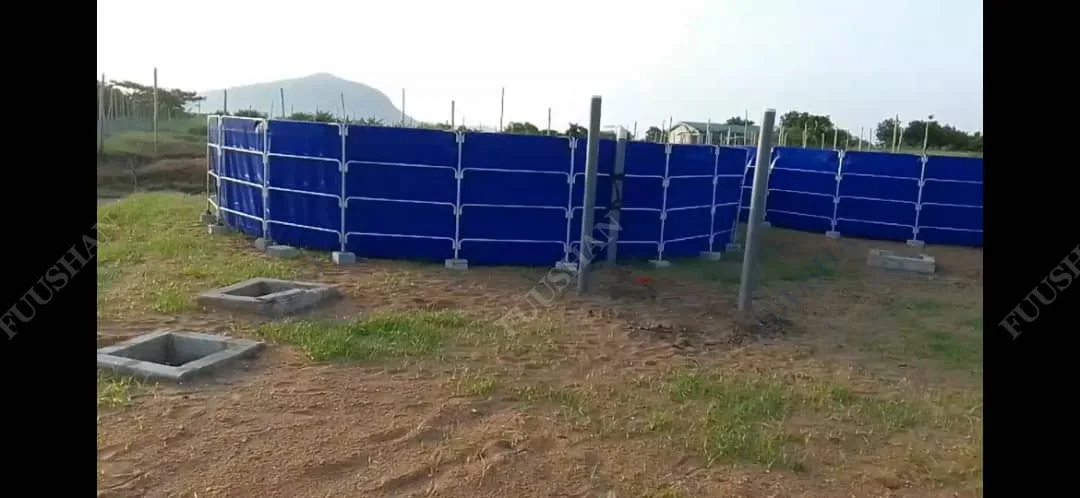
Galvanized pipe frame tanks. Galvanized pipes and fittings form a modular external frame around a flexible PVC liner. Round and rectangular layouts are possible, and the frame assembles without heavy lifting gear, which suits medium farms and warehouses with narrow doors. See the galvanized pipe frame tank specifications.
Folding PVC tanks. Support legs or bracket frames carry a pre-welded flexible PVC body. The structure is light, packs into a crate, and relocates with minimal crew time, so it fits nurseries, quarantine and temporary holding. See the collapsible PVC tank specifications. A delivered pipe-frame project is documented in our Africa fish tank case.
The structures differ in site handling. Bolted panels are assembled ring by ring and treated as semi-permanent; pipe frames arrive as tube bundles and clamp together; folding tanks collapse into a bundle when drained. Base preparation and assembly time differ with structure and soil. The right choice follows from site access, permanence and how often the tank moves.
Each structure page states its own reference range, and final dimensions are confirmed per project.
Flexible PVC Liners and Seam Integrity: Standard Specs vs. Project-Confirmed Details
In all three designs, the frame or steel wall carries the load while the liner holds the water. The liner stays in contact with the culture water, the stock and the bottom aeration hardware.
The flexible PVC panels are thermally welded into a tailored bag that matches the frame geometry, and seam continuity is inspected at the factory before packing; our quality control and seam inspection covers what is checked. Seam integrity is verified before dispatch.
In the field, mechanical damage during setup can cause early liner trouble. A liner pinched between a steel panel and rough ground, abraded by unshielded diffuser weights, or stretched over an unpadded rim will wear prematurely. A protective geotextile underlay, padding on the top edge of steel panels and a little slack in the bottom corners are common site practices, confirmed per project where used.
Other liner parameters are confirmed per project: fabric weight and thickness, the welding detail around outlets, the water source and salinity, and contact suitability. The exact specification belongs in the written order confirmation.
Contact suitability is confirmed per project. That is the position FUUSHAN states in specifications and tender responses, and no blanket water-contact claim is made.
Defining Scope Boundaries for Drains, Valves, and Aeration Interfaces
Many delays come from a scope line never drawn between the container supplier and the system integrator. Three interfaces need clear ownership before manufacturing starts.
Drains and valves. Bottom outlets, side overflows, flanges and isolation valves are part of the tank configuration, and their position, port diameter and connection standard are confirmed per order. On circular tanks with central drains, the outlet pipe typically runs underneath the tank floor in a pre-dug trench where the project requires it, before rising to a standpipe or filter box. That trench and the below-floor pipework are site civil works, not part of FUUSHAN's supply. In many shipments, fitting the drain flange or valve on site is recommended, because a rigid fitting inside a folded liner roll can crease or chafe the fabric. The order sheet should state whether ports are factory-fitted or supplied loose.
Aeration and water treatment hardware. Diffusers, air hoses, blowers, oxygen cones, drum filters, skimmers and their manifolds are not part of FUUSHAN's supply; the system designer specifies and sources them. Where aeration grids rest on the tank floor, the buyer should confirm how they are weighted and padded so they do not chafe the liner.
Who does what. FUUSHAN supplies the tank structure, the flexible PVC liner, the agreed outlets and valves, and assembly guidance. The farm or its contractor prepares the ground and assembles the tank. The system specialist handles equipment integration, biological start-up, and water treatment and aeration design. A six-line matrix covers it: base works, tank and liner, assembly guidance, on-site labour, treatment and aeration, start-up. Each line gets one owner.
Site Preparation, Unloading, and On-Site Assembly Responsibilities
The foundation decides whether the tank stands plumb and spreads the load. The ground must be level, compacted and stable, able to bear the filled tank without differential settlement, with perimeter drainage that keeps rainwater out of the sub-base. Depending on structure, diameter and soil, the base is typically a compacted sand pad with a curb or a level reinforced concrete slab, confirmed per project. Where a central bottom drain is used, the sub-floor pipe and elbow are typically trenched and backfilled flush before the wall goes up. A soft or uneven base shows up as an out-of-round wall or a strained liner.
Materials arrive packed, so the farm needs vehicle access and dry staging away from sharp debris. Packed dimensions and weights are confirmed after packing, not from a drawing; our guide on export packing and delivery explains.
Assembly follows a fixed sequence: verify base level and drain alignment, erect the frame or panel wall, lay the underlay and edge protection if the project specifies them, position the liner, fit the outlet and fittings, then run a shallow test fill to check valve seals. FUUSHAN provides assembly guidance. The crew is the farm's or its contractor's, and the system specialist handles biological start-up; on-site installation labour and commissioning are outside our scope.
10 Technical Inputs to Prepare Before Requesting a Tank Quotation
The quotation is only as accurate as its inputs. Prepare these ten items before you send an enquiry:
Missing items become assumptions that later trigger redesigns and price revisions. Submit the checklist when you send your tank requirements, and the structure, liner and port configuration can be reviewed before a price is issued.
Frequently Asked Questions About Land-Based Aquaculture Tanks
Can these tanks be used with seawater or brackish water?
Seawater, brackish water and coastal sites can be reviewed, but the liner and fitting materials must be confirmed per project. Water source and salinity are checked, so no standard configuration suits every marine site.
Do you supply RAS filtration equipment, blowers or aeration diffusers?
No. FUUSHAN supplies the tank, liner and agreed ports and valves. Filtration, blowers, diffusers, pumps and biological design come from the project's specialists.
Do you send technicians to install the tank on site?
We provide assembly guidance. Our scope ends there: the farm or its contractor assembles the tank, and the aquaculture specialist handles commissioning.
What liner material is used, and how is water-contact suitability confirmed?
The tank uses a thermally welded flexible PVC liner. Fabric weight and thickness follow the structure, water depth and site, and contact suitability is confirmed per project.
What tank diameters and heights are available?
Dimensions are configured per project, not restricted to a stock size. Each structure page states its own reference range, and the final diameter, height, operating depth and liner specification are confirmed against your footprint and transport plan.
Can you tell me how many fish I can stock in a given tank volume?
No. Stocking density is a biological and engineering decision, not a tank-manufacturing rule. It depends on species, temperature, oxygen, aeration, filtration and feeding, and must be set by the consultant who designs your system. The tank provides the volume; your specialist decides how it is stocked.