
APPLICATION · LIVESTOCK & FARM WATER
Water Bladders for Livestock and Remote Farms
Collapsible water bladders for irrigation support, livestock operations and temporary farm storage. The intended water use, capacity, site exposure, fittings and destination are reviewed before quotation.
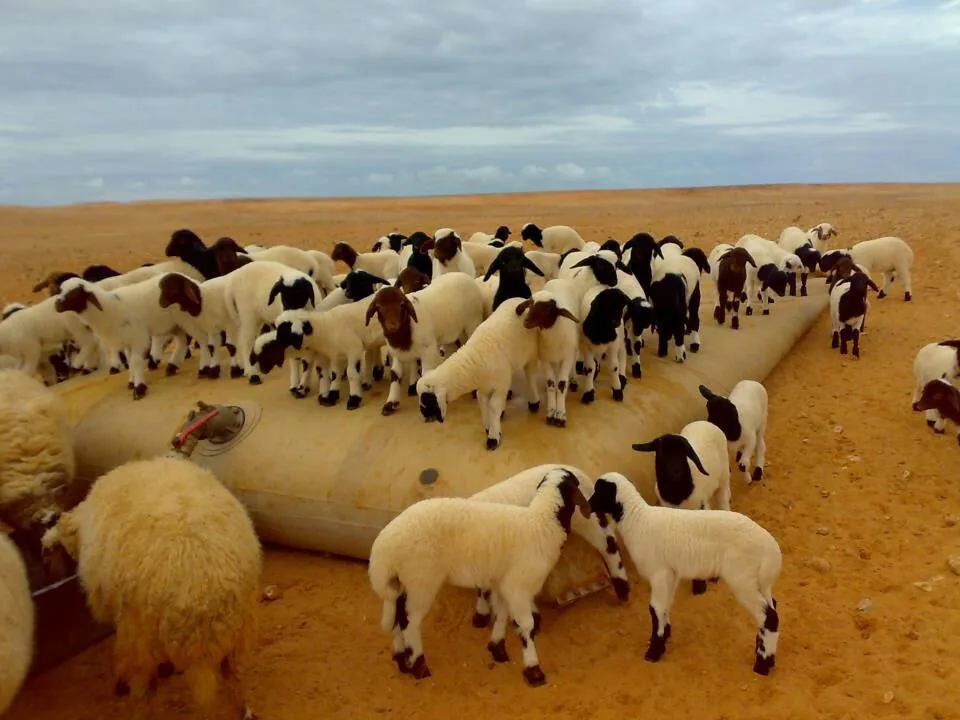
Match Storage to Farm Requirements
- Remote farms and pasture areas often lack a reliable piped water supply
- Livestock need a dependable water volume through dry seasons
- Rigid tanks are costly to transport to remote sites and difficult to relocate
- Water quality and source vary: bore water, trucked water, rainwater
- Seasonal demand changes the storage requirement
- Fittings must match existing pumps, hoses and watering systems
- Installation sites may be uneven or change with the season
Match Storage to Farm Requirements
The configuration below is typical for livestock and farm water storage; it is not a mandatory standard for every farm.
Valves, inlet and outlet connections, Port sizes and positions matched to the existing pump, hose and watering equipment.
Optional protective and handling components, Accessories are confirmed for the project at quotation.
Water Use, Exposure and Connections
Confirmed per project:
Material and Use Requirements
Non-potable Farm Water Storage
Commonly used for non-potable farm and general water storage, including bore, trucked or rainwater where potable-grade material is not required.
Higher requirements
Selected for higher requirements. Polyether TPU may be considered for potable-water candidates, subject to review of the water source and animal-watering documentation.
Water intended for animal consumption requires project-specific review of the water source, material, inner surface and fittings. Human potable-water use and any required food-contact documentation are confirmed separately. Water-source quality should be checked by the farm owner against the intended use.
Site Planning
Planning-level considerations (not an installation manual):
Level the base
Level the base and remove sharp objects to support the filled bladder evenly and reduce puncture risk.
Match the footprint
Match the filled bladder footprint to the available area while preserving livestock access.
Plan access
Plan delivery and refilling access for the truck and watering pump.
Position inlet and outlet
Position inlet and outlet connections for short, accessible hose runs to troughs and the refill point.
Consider seasonal relocation
Consider seasonal relocation to follow grazing rotation or dry-season demand without permanent storage at each site.
Protect against livestock contact
Where needed, protect the bladder from hooves, rubbing and chewing.
Review local requirements
Review layout, volume and discharge plans against local water-use, storage and permit requirements and the farm's water allocation.
These points are for project planning and configuration only. They are not a substitute for a site-specific installation procedure, risk assessment or local regulatory review.
Why Use Flexible Water Storage
Folds empty for transport
Folds empty to reduce transport volume for remote-site delivery.
Project-specific capacity
Configure capacity for herd size and seasonal demand.
Material confirmed against the water source
Material is reviewed against the water source and intended use.
Relocatable between sites or seasons
Bladders fold empty and can be relocated between sites or seasons.
Existing Pump and Watering Connections
Inlet, outlet and valve positions are matched to the existing equipment.
Practical without permanent piped infrastructure
Provides storage for remote paddocks and dry-season use where permanent piped supply is unavailable.
Queensland Reference: 100,000 L Irrigation Storage
This is a related agricultural water-storage reference, not a livestock-performance claim.
The project record describes a 100,000 L pillow bladder tank replacing a leaking steel tank for irrigation buffer storage, with an outdoor-use material configuration. The customer reported support through one full drought-season irrigation cycle under their site conditions. This is project evidence, not a universal performance promise.
This record reflects one project and an agricultural water-storage application; it is not a livestock-specific record and is not a guarantee of identical results for every order.
Common Questions
What water storage is suitable for livestock?
Flexible water bladders are commonly used where remote or seasonal conditions make fixed tanks impractical. Capacity, fittings and material are confirmed against the water source and herd requirement.
Can the bladder store water for livestock drinking?
Water for livestock drinking can be considered subject to project review. The water source, material, inner surface, fittings and any documentation required for animal-watering use must be confirmed before quotation. Human potable-water applications are reviewed separately.
What capacity is needed for a farm?
An initial planning estimate can be based on daily water requirement (herd size and consumption) multiplied by the planned days between replenishment, plus an operational reserve. Final capacity depends on the site, seasonal demand and local requirements.
Can the bladder be relocated between seasons?
Yes, bladders fold empty for transport and can be relocated, subject to the site and handling conditions.
What materials are used?
PVC for non-potable farm storage; TPU (including polyether TPU) for higher requirements or potable candidates. Material is confirmed against the water source.
How is the bladder connected to existing equipment?
Inlet, outlet and valve positions are confirmed against the existing pump, hose and watering system.
How are bladders packed for shipment?
Bladders are folded, protected and prepared for export packing, with container loading coordinated for the destination.
What information is needed for a quotation?
Water source, required capacity, herd size or daily use, site area, pump and fitting details, destination country and expected schedule.
Discuss Your Water Storage Project
Include the required volume, connections, exposure conditions, quantity and destination for review.
Request a Farm Water Storage Quote