
Ordering a fuel bladder by volume alone leaves practical site questions unresolved. Two 10,000 L tanks can share the same nominal capacity while requiring completely different footprints, fabric grades, and valve connections once placed inside a generator skid, a narrow equipment bay, or a lined containment berm.
Getting a workable specification means matching five details before production starts: the exact fuel grade, the site operating conditions, the required working volume, the clear installation footprint, and the inlet and outlet hardware. FUUSHAN manufactures custom TPU fuel bladders from 50 L to 500 m³ (500,000 L) for individual custom pieces, OEM equipment integration, distributor stock batches, and multi-tank engineering projects.
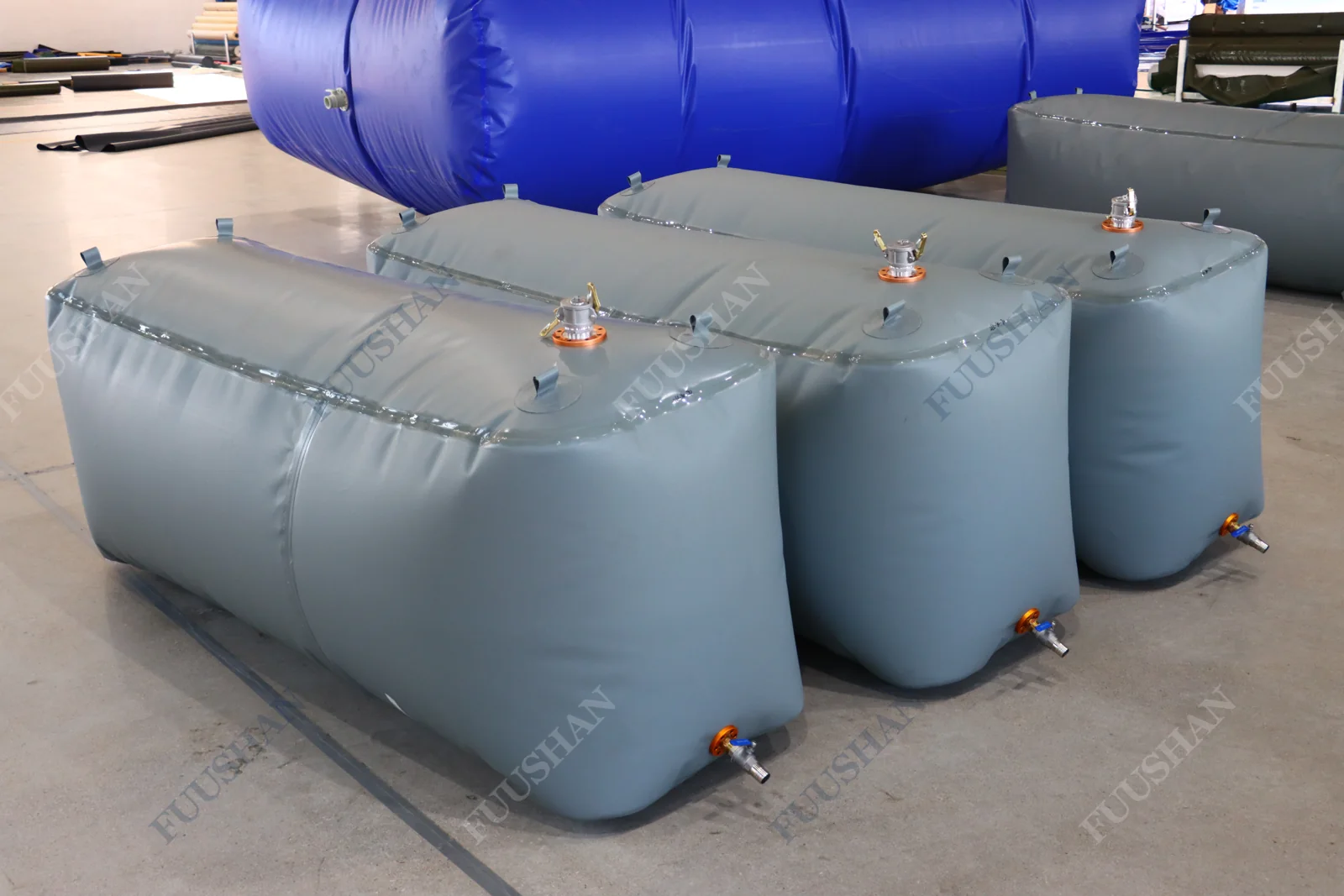
This guide walks through how a collapsible fuel tank fits different field operations, how to compare it against a rigid tank, which TPU material matches diesel or gasoline, how pillow-tank geometry behaves as it fills, and how to choose port sizes from standard 2-inch inlets and 1/2-inch to 2-inch outlets up to 2-inch to 3-inch high-flow connections. If you already know your volume and space limits, jump straight to the quotation checklist at the bottom of the page.
Where does a custom fuel bladder fit your operation?
A flexible fuel bladder—often called a collapsible fuel tank or fuel pillow tank—is a stationary storage container welded from fuel-compatible TPU-coated fabric. When empty, the tank folds into a compact carton or crate for transport; when unrolled on a prepared flat surface, it expands into a low-profile pillow geometry as fuel enters through the inlet assembly.
Because the fabric shell adapts to custom lengths and widths, buyers use flexible bladders across a wide span of capacities rather than a single standard tank size. Before requesting a quote, identify which capacity tier and operating pattern match your project.
Common fuel storage scenarios and capacity tiers
The table below gives illustrative capacity bands and configuration questions for a custom tank. They are starting points for discussion, not fixed limits for each application.
| Application scenario | Illustrative capacity range | Primary configuration focus |
|---|---|---|
| Equipment frames, mobile lighting towers, and small day tanks | 50 L – 500 L | Internal bay clear length, width, and height; exact port locations and valve handle clearance inside the frame |
| Standby generators, telecom sites, and medium construction pads | 1,000 L – 10,000 L | 2-inch filling port, 1/2-inch to 2-inch supply outlet matched to the transfer pump or generator feed line, and ground mat |
| Remote mining camps, drilling rigs, and seasonal exploration sites | 10,000 L – 50,000 L | Road or air-freight packing weight, secondary containment berm sizing, dust protection on quick couplings, and sun or cold exposure |
| Bulk fuel depots, power plants, and multi-tank storage farms | 50,000 L – 500 m³ (500,000 L) | Dividing total volume across multiple bladders, 2-inch to 3-inch ports or 3-inch to 4-inch integrated manifold valves, and graded pad layout |
| OEM equipment integration and distributor stock programs | Custom per drawing (single piece or batch) | Repeatable layout drawings, standardized thread and quick-connector kits, unit labeling, and carton or pallet export packing |
If your project involves heavy civil works, remote camps, or earthmoving fleets, see our mining and construction fuel storage application page for how site operators lay out pads, containment berms, and transfer lines in the field.
Define the boundary between the bladder and the fuel system
A fuel bladder quotation covers the flexible tank body, the welded flanges, the selected inlet and outlet valves, quick connectors, and any requested ground cloth, spill containment berm, or repair kit. Transfer pumps, filtration skids, flow meters, dispensing nozzles, and fuel hoses beyond the tank valves are often sourced separately or integrated by your local contractor.
Listing the tank scope and the external piping scope separately prevents gaps at installation. Also tell us upfront if your inquiry involves marine deck placement, aviation ground support, motorsport refueling, or dynamic transport with liquid inside; those scenarios carry distinct restraint and regulatory considerations that must be reviewed individually rather than treated as standard stationary site storage.
Fuel bladder vs. rigid steel or polyethylene tank: which fits your site?
Buyers frequently compare a collapsible TPU bladder against a welded steel tank, a double-walled bunded tank, or a molded polyethylene container. Neither structure replaces the other in every situation; the right choice depends on how the tank travels to the site, how long it stays in one place, and what space you have available.
Evaluate freight, site preparation, and relocation cycles
A rigid tank retains its external dimensions when empty, so freight planning must account for its size, weight and lifting requirements. An empty fuel bladder can be folded for shipment. The actual carton or crate dimensions, packed weight and unloading method depend on the tank and its fittings; confirm these figures before selecting road, sea or air transport.
| Evaluation factor | Flexible TPU fuel bladder | Rigid steel or polyethylene tank |
|---|---|---|
| Empty freight and storage | Folds when empty; confirm packed dimensions, gross weight and handling needs | Retains external dimensions when empty; assess transport and lifting equipment for the selected tank |
| Site preparation | Requires a flat, smooth, well-drained surface free of sharp stones, paired with a ground cloth or liner | Foundation or support requirements depend on tank design, loads and site conditions |
| Secondary containment and protection | Paired with a foldable spill containment berm and perimeter fencing around vehicle traffic lanes | May use a double wall or separate containment; confirm impact protection and local site requirements |
| Service pattern and relocation | Well suited for temporary, seasonal, emergency, or multi-stage projects where the drained tank moves to the next site | Well suited for permanent fixed installations with long-term stationary piping and civil works |
| Custom footprint adaptation | Length, width, and port coordinates can be tailored to fit irregular bays, skids, or narrow pads | Check available standard sizes and obtain a quotation for any custom fabrication or tooling |
Stationary storage vs. dynamic transport limits
Standard pillow-style fuel bladders are engineered for stationary storage on a stable, flat supporting surface. Once fuel enters the bladder, the liquid shifts dynamically if the supporting platform moves, brakes, or tilts. Do not lift, drag, tow, or transport a standard storage bladder while it contains fuel unless the tank and restraint system have been specifically engineered and confirmed in writing for that use.
Similarly, a bladder's nominal capacity (such as 5,000 L or 50,000 L) describes its working liquid volume on a flat pad, not a pressurized vessel rating. Gravity feed or controlled pump transfer must stay within the agreed filling height and operating instructions so the welded seams are not subjected to overfill pressure.
How to select the right TPU material for diesel, gasoline, or blends
Coated fabrics for water and fuel can look similar. Appearance alone does not establish compatibility: the coating, reinforcement, seams and seals must be assessed for the specified fuel, temperature and contact duration.
Polyester TPU, polyether TPU, and why standard PVC is excluded
FUUSHAN manufactures TPU fuel bladders from thermoplastic polyurethane-coated reinforcement fabric. Standard PVC water-bladder fabric is not our specified fuel-bladder material. A fabric approved for water should not be substituted for a fuel-compatible fabric without reviewing the exact formulation and service conditions.
Within the TPU family, selecting the polymer backbone starts with the liquid you plan to store:
- Polyester-based TPU is commonly specified for diesel, gasoil, and kerosene storage, where resistance to mineral oils and hydrocarbon swelling is the primary requirement.
- Polyether-based TPU or specialized multi-layer fuel barrier constructions may be evaluated when the application involves gasoline, ethanol-blended fuels, or high-humidity environments where hydrolysis resistance is also a concern, subject to compatibility confirmation against the exact fuel specification.
Fuel grades, additives, and ambient temperature ranges
When requesting a material recommendation, tell us the specific fuel grade rather than writing only "fuel" or "oil." Specify whether the liquid is standard ULSD diesel, winter-blend diesel with cold-flow additives, biodiesel (such as B5, B20, or higher FAME content), jet fuel, or unleaded gasoline with ethanol (such as E10). If you have a Safety Data Sheet (SDS) or fuel specification sheet, attach it to your inquiry so we can verify both the TPU fabric coating and the valve gasket and seal materials.
Operating environment matters just as much as liquid chemistry. Share your expected minimum and maximum ambient temperatures, whether the bladder sits indoors, under a sunshade canopy, or in direct desert sunlight, and whether the empty bladder will be unrolled and folded in freezing conditions. Providing the actual climate and storage duration allows us to recommend an appropriate fabric weight and TPU compound without relying on generic catalog assumptions.
How to size a custom tank from 50 L to 500 m³ around your space
Our custom manufacturing range spans from 50 L auxiliary bladders up to 500 m³ (500,000 L) bulk storage units. Turning a target volume into a physical tank that fits your site requires matching the liquid capacity with the clear footprint and height available on the ground.
Clarify units, working volume, and refill intervals
Always include the unit of measure when stating capacity. One cubic meter (1 m³) equals 1,000 liters (1,000 L). If your team works in gallons, specify whether you mean US gallons (1 US gal ≈ 3.785 L) or Imperial gallons (1 Imp gal ≈ 4.546 L)—a 10,000-gallon request differs by more than 7,600 liters between the two systems.
Work from daily fuel consumption and the resupply interval. For example, consumption of 2,500 L per day over 7 days requires 17,500 L, before adding a reserve for delivery delays. To illustrate a multi-tank layout, four 50,000 L bladders provide 200,000 L in total. The number of tanks, reserve volume and isolation arrangement should be reviewed against your operating plan.
Why pillow tank geometry differs from a rigid rectangular box
A common sizing mistake is calculating a flexible bladder's volume by multiplying length × width × height as if it were a flat-sided steel box. Because a pillow tank is welded around its perimeter seams, its edges curve inward and the top surface crowns as liquid fills the chamber. As the bladder fills, its footprint draws slightly inward from its flat empty dimensions while its center height rises to the designed working profile.
When measuring an equipment bay, container floor, or secondary containment berm, give us the internal clear length, clear width, and any overhead height limit. Account for structural ribs, door frames, and extra working room around the flanges so an operator can attach a Camlock hose and turn the ball valve handle without hitting a wall. Before production, we prepare a layout drawing showing both the empty flat dimensions and the filled working profile so you can verify fitment against your site pad.
How to specify inlet and outlet ports, valves, and connector types
Even a properly sized tank causes delays on site if its outlet thread does not mate with your transfer pump hose, or if plastic water-tank fittings were supplied where metal fuel hardware is required. Confirming the port sizes, valve materials, quick-connector types, and port positions on the layout drawing removes guesswork before welding begins.
Standard port diameters and high-flow options for larger tanks
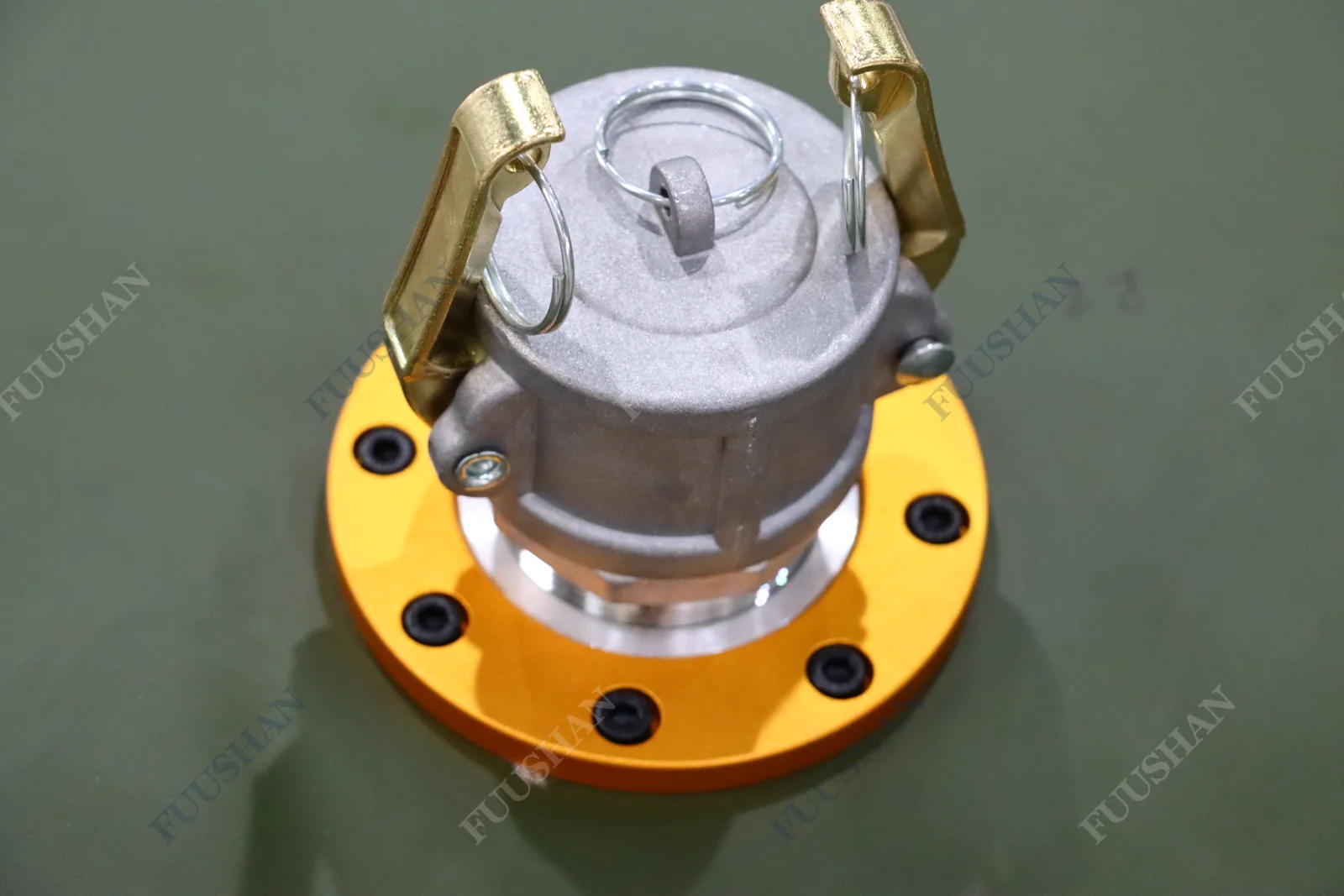
Unlike standard water bladders that often use polypropylene (PP) plastic fittings, FUUSHAN configures fuel bladders with metal hardware—typically aluminum flanges paired with stainless steel ball valves and metal quick couplings—to maintain mechanical strength and hydrocarbon compatibility at the connection points.
Our standard and high-flow port configurations follow practical field transfer requirements:
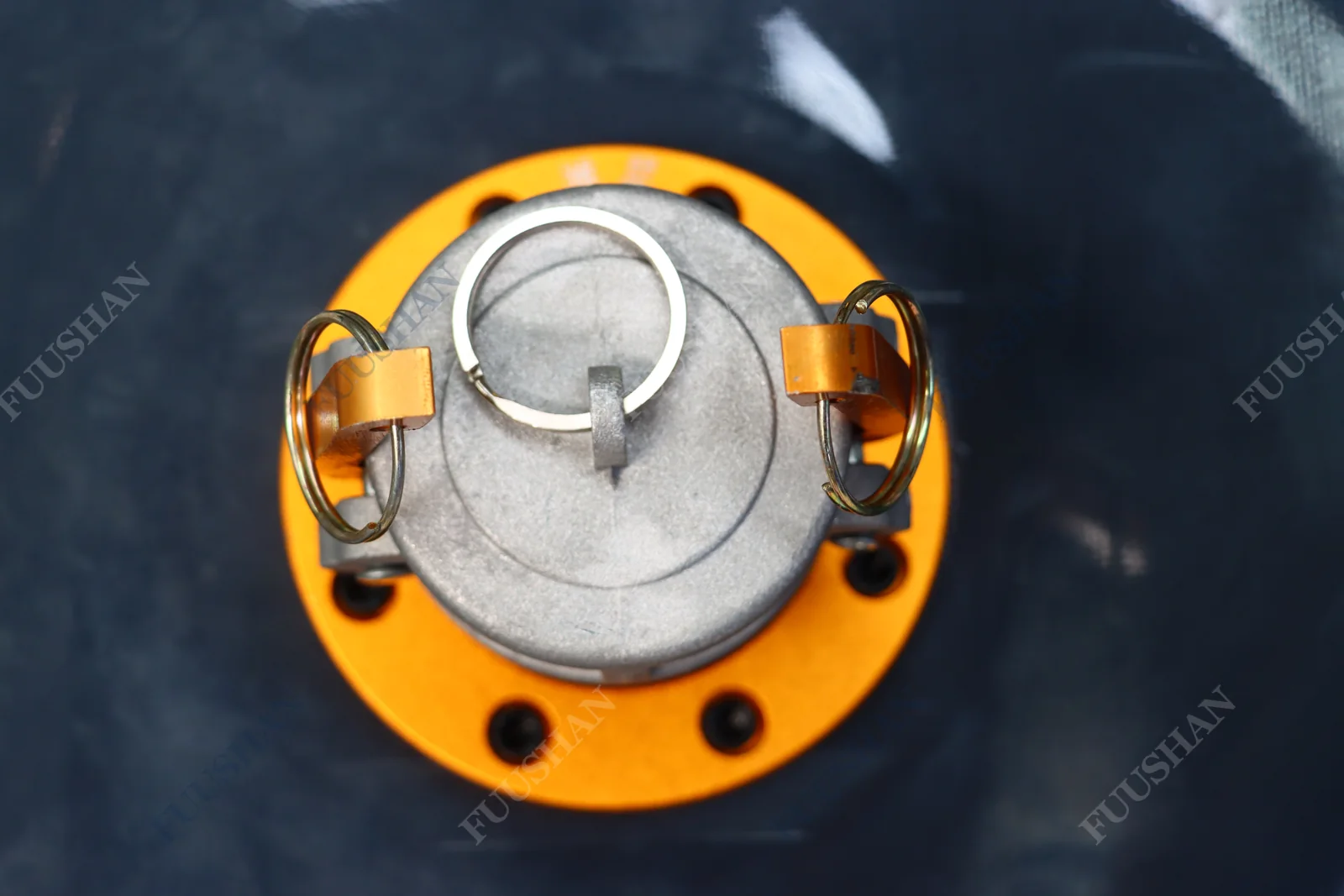
- Standard inlet size: Commonly configured at 2-inch, typically equipped with a Camlock quick connector and a chained dust cap to match standard tanker delivery hoses and transfer pumps.
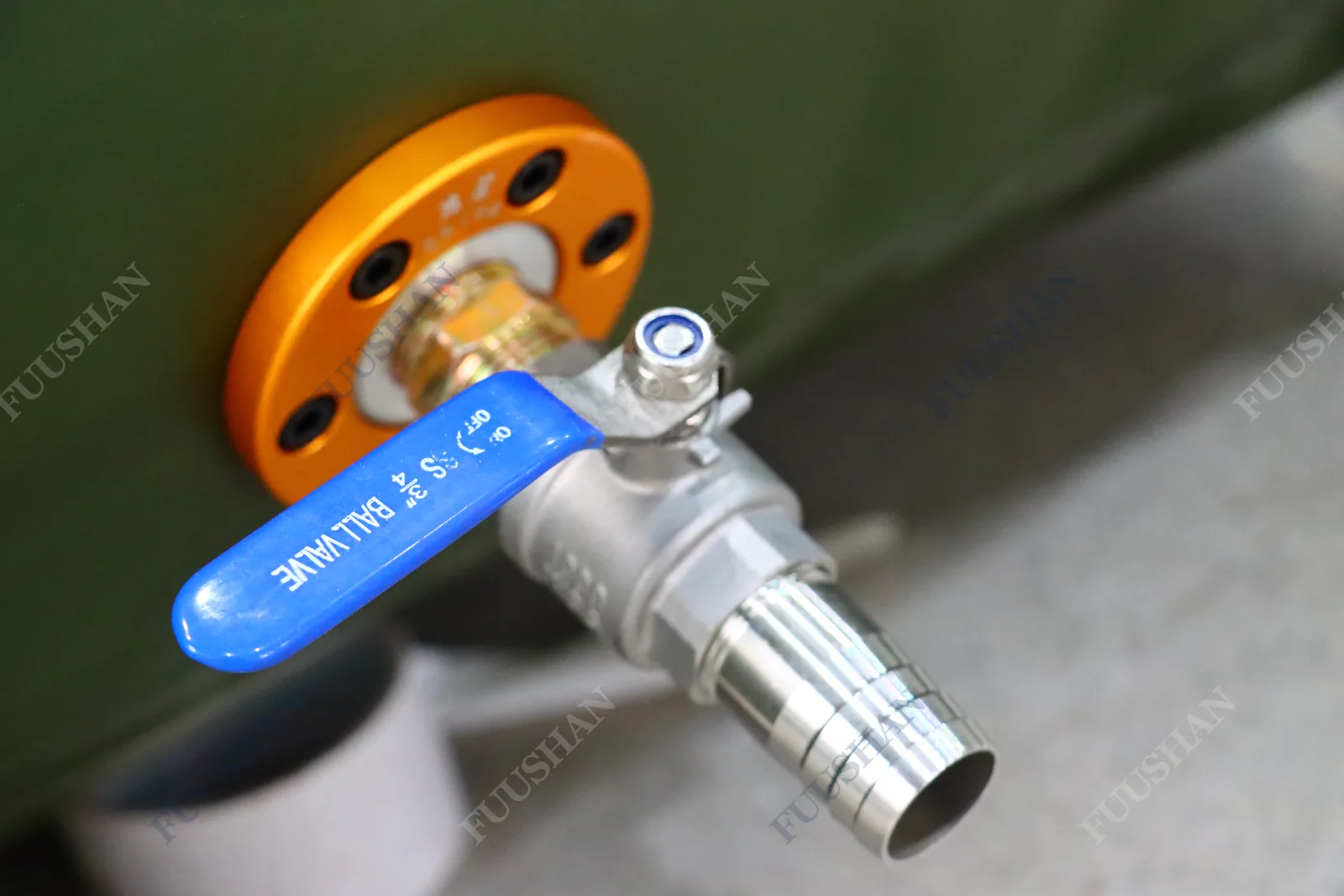
- Standard outlet sizes: Commonly configured in 1/2-inch, 3/4-inch, 1-inch, or 2-inch diameters depending on whether the bladder feeds a compact generator return/supply line or a larger transfer pump. Standard outlets pair a stainless steel ball valve with a C-type (female coupler with hose shank) or F-type (male adapter with external thread) Camlock quick connector.
- Large-capacity bladder ports (2-inch to 3-inch and above): For larger fuel or water bladders where higher filling and discharge flow rates are needed, both inlets and outlets can be upgraded to 2-inch to 3-inch ports. For bulk depot manifolds and high-flow transfer lines, 3-inch and 4-inch integrated valves are also available upon specification review.
| Port function | Standard and optional sizes | Typical hardware and mating assembly | Common application match |
|---|---|---|---|
| Standard fill inlet | 2-inch | Aluminum flange + Camlock quick coupling + dust cap (optional isolation ball valve) | Standard tanker delivery hose or portable transfer pump filling |
| Small and medium discharge outlets | 1/2-inch, 3/4-inch, 1-inch | Aluminum flange + stainless steel ball valve + C-type or F-type quick connector / hose tail | Direct feed to diesel generators, heaters, light towers, or compact dosing pumps |
| Standard transfer outlet | 2-inch | Aluminum flange + 2-inch stainless steel ball valve + C-type or F-type Camlock quick connector | Site dispensing skids, fleet refueling pumps, and medium storage tanks |
| High-flow ports for large bladders | 2-inch to 3-inch (plus 3-inch and 4-inch integrated valves) | Heavy-duty metal flange assembly or integrated high-flow valve matched to manifold piping | Large fuel or water bladders, bulk storage depots, and high-throughput transfer lines |
| Top vent / breather port | Sized to tank and pump flow rate | Top-mounted breather or pressure-relief fitting configured for the fuel type | Provides an air-release point where specified; venting and pressure limits must follow the confirmed tank design and operating instructions |
When specifying threads alongside quick couplings, state whether your local piping uses BSP, NPT, or flanged connections, and confirm whether your hose ends are male or female so the mating adapter arrives ready to connect.
Port placement, valve orientation, and venting on the layout drawing
Where a port sits on the tank body is just as important as its diameter. Top-mounted ports are often used for overhead filling or air venting, while lower side or end ports allow pump suction and gravity drainage near the bottom of the bladder. If a bladder sits inside a steel tray or containment berm, placing an outlet too close to a corner or facing a berm wall can kink the suction hose.
Send a simple hand sketch or mark up our layout drawing to show which side of the bladder faces your pump skid, where hoses exit the containment area, and whether you need a dedicated top air vent or drain port. Reviewing the exact port coordinates before fabrication ensures every valve handle has clear operating room.
What to verify in seam welding, accessories, and export packing
A flexible fuel tank relies on the integrity of its welded seams, the reinforcement patches around its metal flanges, and how the site protects the fabric from ground abrasion. Checking how the tank is built, inspected, and packed helps you compare suppliers on actual manufacturing details rather than catalog photos alone.
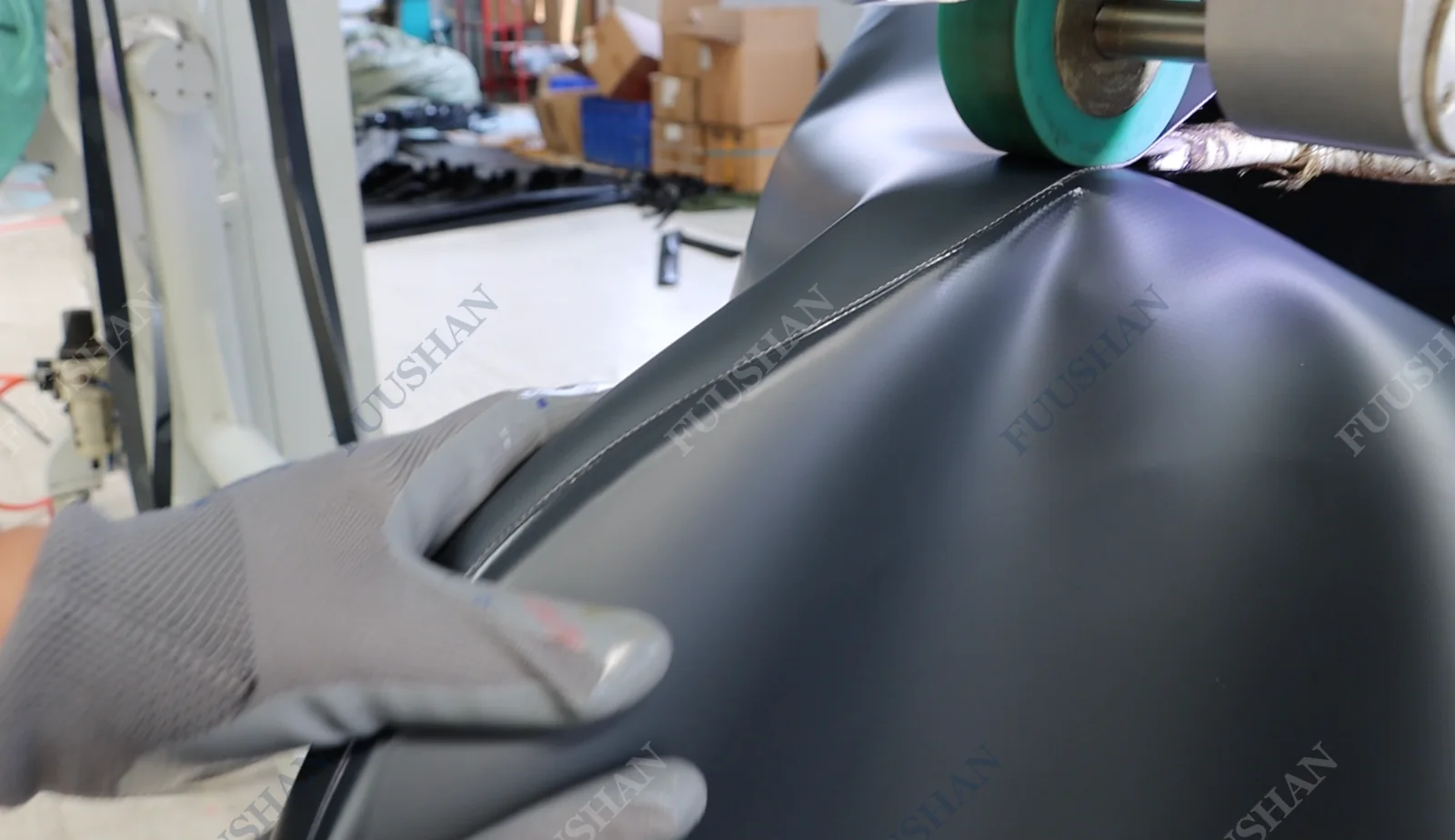
Hot-air welding, seam reinforcement, and pre-shipment checks
FUUSHAN uses hot-air welding and reinforced seam construction for fuel bladders. Experienced workers with 5+ years of industry experience adjust welding parameters to the material and workshop conditions. Reinforcement around corners and flange bases is specified according to the tank design and hardware loads.
During bulk production, our workshop performs random air-inflation spot checks to verify seam integrity and flange sealing. Before packing and dispatch, we provide pre-shipment product and valve photo confirmation so you can check the finished tank layout, port positions, and hardware assembly against your confirmed order. You can review our workshop workflow on our custom manufacturing page and quality control page. If your project requires specific third-party witness inspections or material batch documentation, state those requirements before ordering so they can be scheduled into the production plan.
Handling straps, protective ground mats, and secondary containment berms
Around the perimeter of the bladder, welded fabric handles on circular reinforcement patches allow technicians to unroll, align, and position the empty tank on the pad. These handles are designed exclusively for positioning the empty bladder and must never be used as lifting lugs or towing points when liquid is inside.
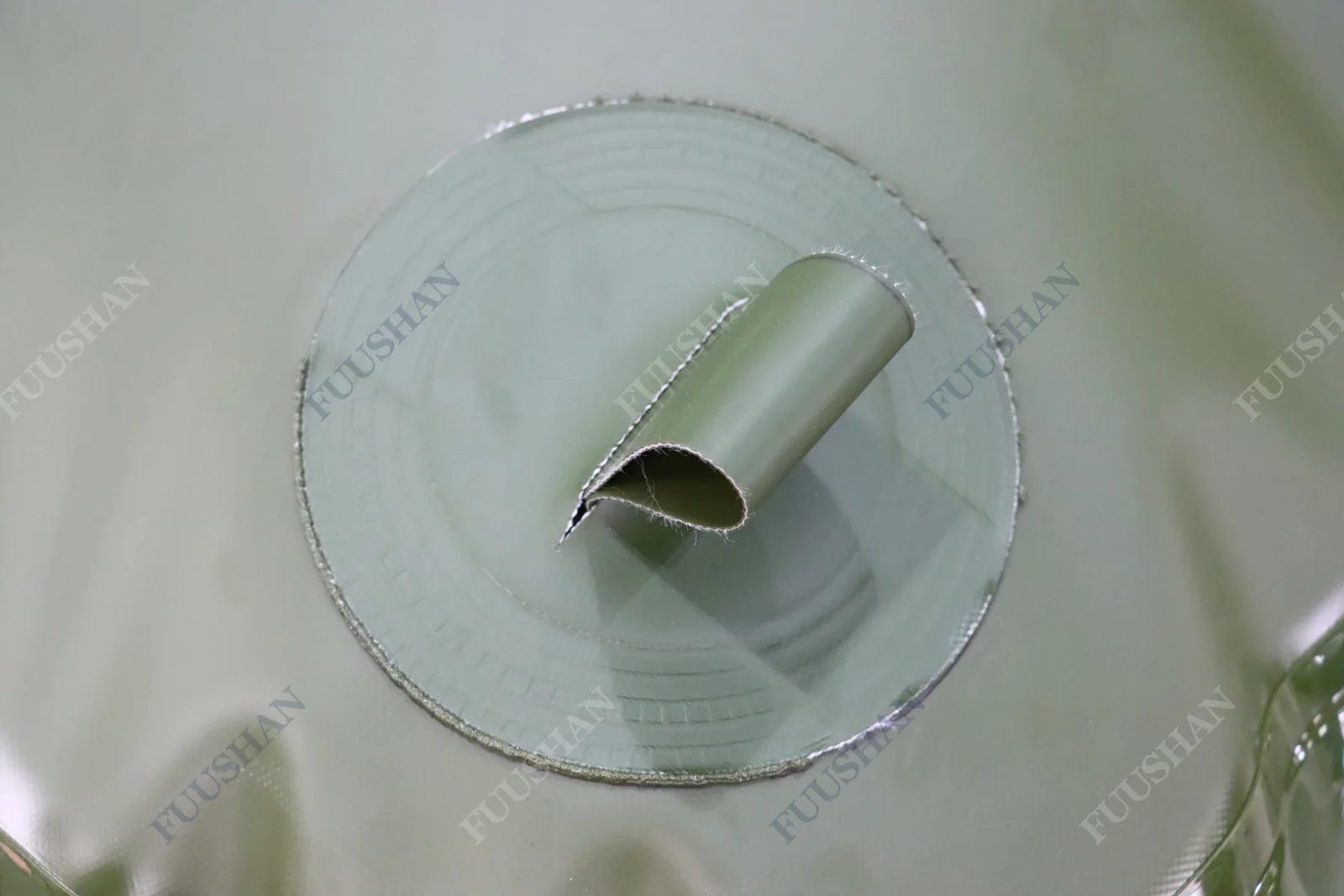
For field deployment, we recommend pairing the fuel bladder with a protective ground mat and a secondary containment enclosure. A ground cloth separates the bottom TPU fabric from rough soil, gravel, or concrete expansion joints, while a foldable spill containment berm creates a secondary basin around the tank and valve manifold. Because required containment volume and wall clearances depend on your site rules and local regulations, tell us the berm footprint or capacity ratio your project specifies so we can size the bladder and berm as a matched set.
Export packing, repair kits, and operation guidance
Before folding an empty fuel bladder for shipment, protruding aluminum flanges and stainless steel valves need cushioning so metal edges do not chafe the folded TPU fabric during ocean or road transit. Depending on tank weight and destination, orders are packed in reinforced cartons, wooden crates, or palletized export boxes with clearly listed gross weights and outer dimensions.
Every custom order can be supplied with a standard field repair kit (matching TPU patches and maintenance accessories) and clear operation guidance covering pad preparation, unrolling, filling limits, and seasonal folding. Make sure any extra spare adapters, hoses, or ground mats you want included are itemized on the quotation list.
How order type, specification details, and freight shape your quote
Comparing two fuel bladder quotes by unit price alone often hides major differences in fabric weight, polymer grade (polyester TPU vs. polyether TPU or misapplied PVC), metal vs. plastic valves, and shipping terms. A transparent quotation breaks down the specification so you can see exactly what drives cost and production time.
Single custom pieces, OEM batches, and multi-tank project orders
Because we cut and weld to confirmed layout drawings in-house, we support flexible order structures without forcing buyers into rigid catalog minimums:
- Single custom pieces and prototype orders: Ideal when you need one custom-sized bladder to fit an existing generator base frame, vehicle bay, or site pad.
- OEM and distributor batches: Repeatable dimensions, unified port kits, custom markings, and palletized packing tailored for equipment builders or regional stockists.
- Engineering project orders: Multi-tank fuel storage packages combining bladders, 2-inch to 3-inch high-flow ports or 3-inch to 4-inch manifold valves, ground liners, and matching spill containment berms.
When requesting a multi-tank quote, state both the quantity and the individual capacity of each bladder—for example, "three 20,000 L diesel bladders" rather than "60,000 L total"—along with your destination port or delivery address and preferred Incoterms (such as EXW, FOB, CIF, or DDP). Once the layout drawing and valve configuration are confirmed, we provide the exact production schedule and packed freight dimensions for your order.
Quotation checklist: what to send for an accurate proposal
You do not need a finished CAD package to start a technical review. Send the operational details you already have using the checklist below, and tell us which items—such as filled height, port coordinates, or berm sizing—you would like our team to propose on the layout drawing.
| Checklist item | Details to include in your inquiry |
|---|---|
| 1. Fuel type and operating conditions | Exact liquid (diesel grade, biodiesel %, gasoline, ethanol blend, or kerosene), SDS if available, ambient temperature range, indoor or outdoor sun exposure, and planned storage duration |
| 2. Target capacity and clear footprint | Working volume with explicit units (L, m³, US gal, or Imp gal) plus available clear length, width, and height inside the pad, frame, or berm |
| 3. Inlet and outlet port specification | Inlet size (standard 2-inch or 2-inch to 3-inch high-flow), outlet size (1/2-inch, 3/4-inch, 1-inch, 2-inch, or 2-inch to 3-inch / 3-inch to 4-inch integrated valve), stainless steel ball valve, C-type or F-type Camlock quick connector, and thread standard (BSP/NPT) |
| 4. Port positions and venting | Preferred inlet, outlet, drain, and top breather/vent locations on the tank (a simple hand sketch or marked photo of the installation bay works well) |
| 5. Accessories and site protection | Whether to include a protective ground mat, foldable spill containment berm, spare quick couplings, or additional repair kits |
| 6. Quantity, destination, and documents | Number of tanks (single piece, OEM batch, or project set), destination country/port, preferred shipping terms, and any required project inspection documents |
Ready to review your specification? Send your parameters through our inquiry page. Even a short note such as "20,000 L diesel storage bladder, two units, 2-inch Camlock inlet and 1-inch stainless ball valve outlet with C-type quick connector, stationary outdoor pad" gives our engineering team enough context to prepare a layout drawing and itemized quotation.